
How Syufy Runs Gyms, Restaurants, Golf and Drive-Ins on One WordPress Network
Welcome to WP for ENTERPRISES, where we go behind the scenes of BILLION-DOLLAR WordPress websites.
In this issue, you'll discover:
- How one company runs four businesses and 27 physical locations on a single WordPress network.
- Why Sitecore was the wrong shape for a business with a lean web team.
- The middleware layer we removed, and why it was costing them twice.
- 5 strategies behind a six-month migration across four unrelated businesses.
- What 20 hours a week back actually means for a team this size.
Every case study I have shared in this newsletter has been a publisher, a government body or a global brand. NASA. Disney. CERN. News Corp Australia. USA TODAY. For most of them, content is the product. The website is the business.
This one is different.
Syufy Enterprises is an entertainment and leisure company based in Marin County, California. Over 1,000 employees. 27 business locations. And a portfolio that has almost nothing in common with itself:
- VillaSport Athletic and Health Clubs: 8 locations across 4 states.
- Tomatina Restaurants: 8 locations around the Bay Area.
- Peacock Gap Golf Club: San Rafael, including the Range Cafe and an event venue.
- Santa Cruz Cinema and West Wind Drive-In Theaters and Public Markets: 7 locations across 3 states.
Nobody visits these websites to read. They visit to buy a gym membership, book a table, reserve a tee time or check what is playing tonight. The site is the front door to a physical location.
Here is the part I like most about this story.
Syufy started in 1941, when Raymond Syufy opened the Rita, a single theatre in Vallejo. The company grew into Century Theatres and sold that chain to Cinemark in 2006. The family kept the drive-ins and swap meets, which now run as West Wind. West Wind opened its first drive-in in 1952 and today it's the largest drive-in chain in the world. Alongside it, Syufy runs gyms, restaurants and a golf club.
Eighty-five years of reinventing the business. And they were stuck on a CMS they could not change.
WHAT WAS BREAKING?
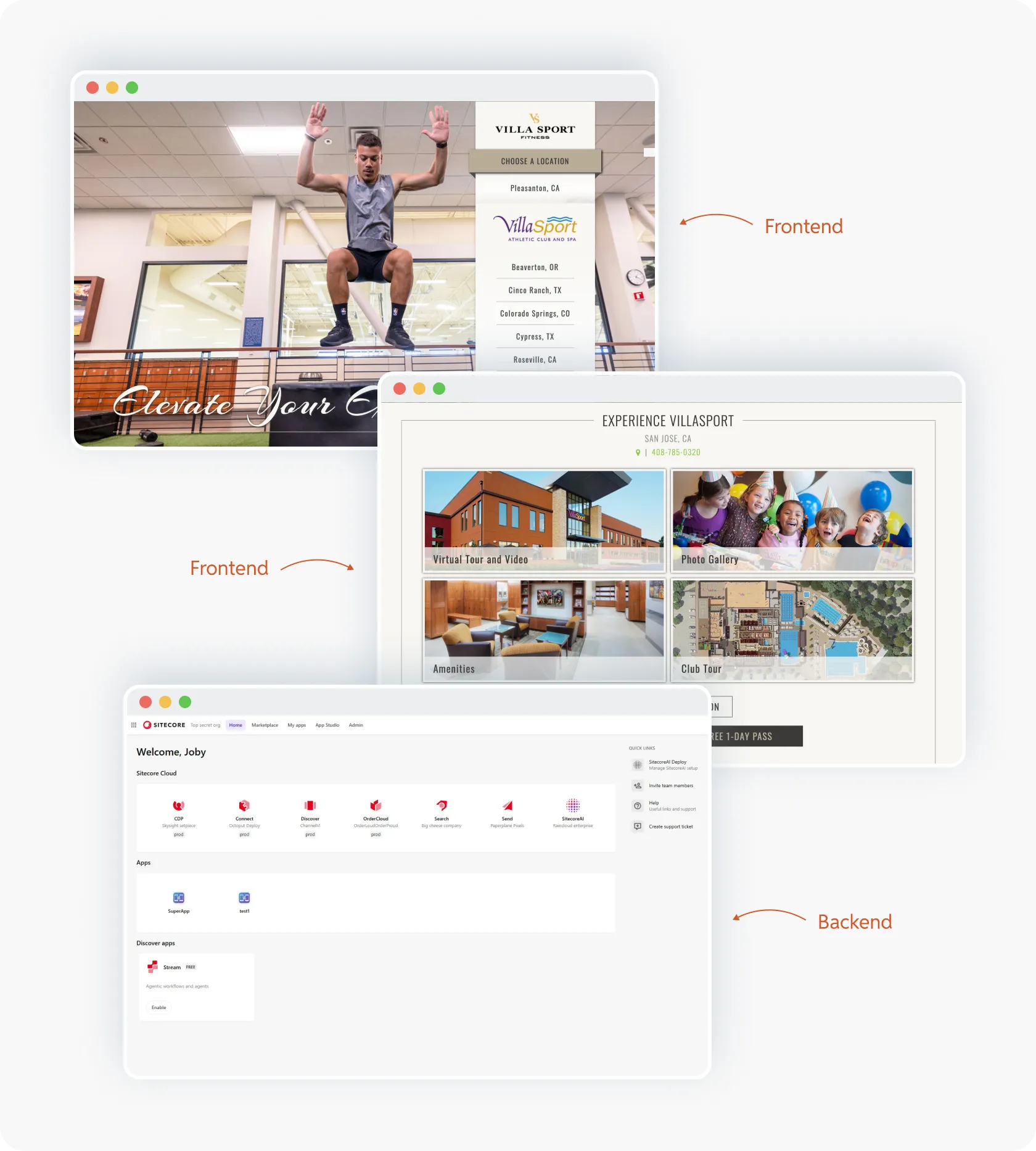
Syufy was running everything on Sitecore. On paper, that is a defensible choice. Sitecore is a serious enterprise platform. In practice, it was the wrong shape for this company.
Problem #1: They were paying DXP prices for a problem that was not a DXP problem
Sitecore is built for global marketing organisations with a dedicated platform team behind it. Syufy is a portfolio operator with a lean web team. The licensing and technical maintenance costs kept climbing while the actual job stayed simple: publish a promotion, update a menu, change club hours.
Problem #2: The backend was slow enough to change behaviour
This is the cost nobody puts in a budget. When the admin is sluggish, marketing teams stop making small changes. A promo that should take ten minutes takes an afternoon, so it waits until Thursday. Then it waits until next week. Then it does not happen.
Marketing agility does not disappear in one dramatic failure. It gets negotiated away, one skipped update at a time.
Problem #3: Middleware sat in the middle of everything
Syufy's sites need to talk to third-party platforms: club management, ticketing, reservations. Between Sitecore and those platforms sat a middleware layer, and every dependency added complexity.
That layer cost them twice. Once to build and maintain it, and again every time something broke and nobody could say which of the three systems was at fault.
Problem #4: Four businesses, one rigid template
A gym, a restaurant chain, a golf club and a drive-in cinema do not want the same page. They do not have the same customer, the same booking flow or the same season. The platform gave each business unit limited room to be itself.
Problem #5: No consistent performance baseline
Some properties performed well. Some did not. Benchmarks varied from one property to the next, with no shared baseline.
The pattern underneath all five: the technology was built for a company that Syufy was not.
WHY WORDPRESS?
Four reasons, and they will sound familiar if you have been reading this newsletter for a while.
Licensing goes to zero. The money that was going to a licence goes into the work instead. For a company with eight sites and no publishing revenue, that maths is not close.
The team can actually use it. No specialist developers on retainer for routine changes. The web team updates a club page the same way anyone updates a WordPress page.
Multisite fits a portfolio company by design. Eight sites, one network, one place to manage them. This is what Multisite was built for.
WordPress VIP gives enterprise hosting without enterprise licensing. Same infrastructure standard that NASA and Ask Media Group run on, minus the annual software bill.
The goal Syufy set was specific: a platform that was more cost-effective, faster, more flexible and easier to use, and one that could carry the portfolio as it kept expanding.
5 STRATEGIES BEHIND THE MIGRATION
Multidots led the move from Sitecore to a WordPress VIP Multisite network over six months. Here is how it was built.
Strategy #1: One network, not eight rebuilds
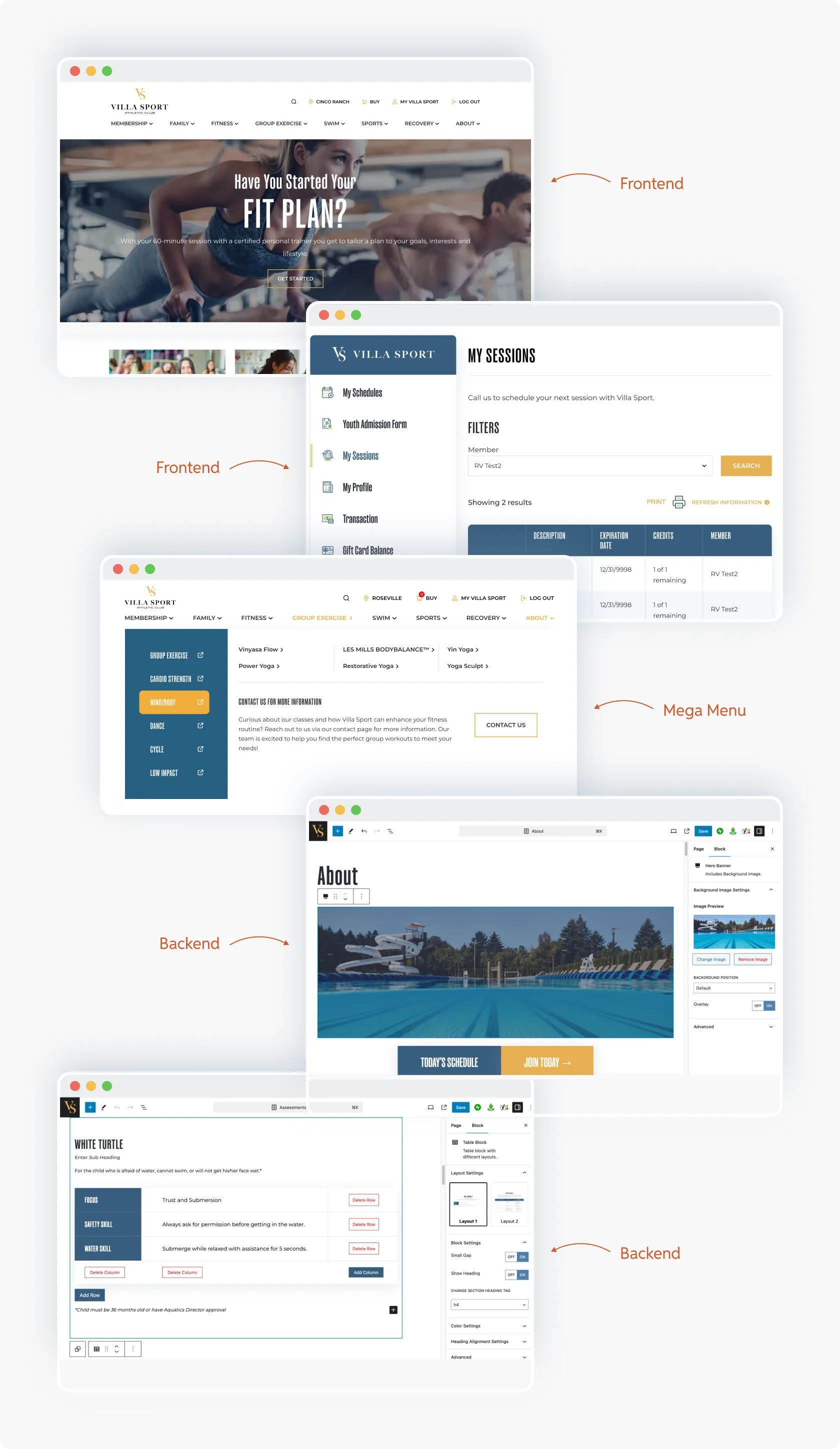
Every brand went onto a single WordPress VIP Multisite network. Shared core, shared plugin set, its own theme and identity per brand.
The advantage compounds quietly. A security patch lands once and covers all eight sites. A platform upgrade is one project instead of eight. A new capability built for VillaSport is available to Tomatina the same day.
This is the same principle behind Disney's "Aloha" parent theme and News Corp Australia's Site Production Platform. The interesting thing is that it works just as well at 8 sites as it does at 90. You do not need to be a media giant to get the benefit.
Strategy #2: Delete the middleware
This is the most useful engineering lesson in the whole project.
Instead of keeping the translation layer, we had WordPress communicate directly with the third-party platform APIs. Middleware was reduced across the board and removed entirely in several places.
Middleware is rarely a decision. It accumulates. A platform cannot reach a system, so someone builds a bridge. Then a second bridge. Five years later, the bridges are the architecture, and every one of them is a cost line, a latency hit and a thing that can fail at 2 a.m.
If you are planning a migration, audit the layers between your CMS and your other systems before you audit the CMS. You will often find that half of them exist because of a limitation you are about to remove anyway.
Strategy #3: Optimise per property, not per platform
Front-end performance work was done property by property rather than as one platform-wide pass.
That is why the result is a range and not a single number. Improvements landed between 20% and 60% depending on the site, with a 25% average across the eight properties.
Strategy #4: One dashboard for 27 locations
This is the change the team feels every day.
Promotions, offers and sales across 27 business locations are now managed from a single place. One login. One set of tools. Publish once, push it where it needs to go.
Amanda Settewongse, Digital Marketing Director at Syufy, put it plainly:
"We can now easily manage content across multiple sites from a single dashboard, greatly simplifying our processes."
For a company running a Bay Area restaurant promotion and a Texas gym campaign in the same week, that is the difference between a marketing calendar and a scheduling problem.
Strategy #5: Fit the platform to the team you have
The lesson I keep coming back to.
Most CMS evaluations ask which platform is most capable. That is the wrong question. The better question is which platform your actual team can operate on a Tuesday afternoon without filing a ticket and waiting three days.
Sitecore assumes a dedicated platform team standing behind it. Syufy has a lean web team supporting four unrelated businesses.
THE RESULTS
The migration delivered across performance, cost and time:
- 20% to 60% improvement in front-end performance benchmarks.
- 25% average improvement across eight properties.
- Six months from start to finish.
- Centralised control of content and sales across 27 business locations.
And the number I find most telling, the weekly time returned to the team:
- Santa Cruz and West Wind: an estimated 20 hours a week.
- Tomatina: an estimated 8 hours a week.
- Peacock Gap: an estimated 5 hours a week.
- VillaSport: an estimated 5+ hours a week.
Add that up and it is most of a full-time role, recovered every single week, from a platform change. That capacity did not come from hiring. It came from removing friction that everyone had stopped noticing.
FINAL THOUGHTS
Syufy is a smaller story than NASA or News Corp Australia. I think it is a more useful one, because most companies reading this look more like Syufy than like NASA.
✅ Audit your middleware before you audit your CMS. Some of those layers exist only to work around a limitation you are about to migrate away from.
✅ Eight sites and one team is a textbook Multisite case. You do not need 90 brands for the maths to work.
✅ Match the platform to your team size, not your revenue. A platform your team avoids using is an expensive shelf.
If a company running gyms, restaurants, a golf club and a chain of drive-in theatres can operate all of it from one WordPress network, a single-brand enterprise has fewer excuses than it thinks.
IN CASE YOU MISSED IT
By the way, in the previous issue, I shared "How NAB Show, NASA, and USA TODAY keep billion-dollar WordPress platforms healthy long after go-live". Check it out here.
In this issue, you'll discover:
- Why the real work on an enterprise platform starts the day after launch.
- The CI/CD pipeline that lets teams ship code without holding their breath.
- The one syncing rule that prevents most production disasters.
- How blue-green and canary deployments push updates with zero downtime.
- A 4-stage maturity model to benchmark your own DevOps.
 Anil Gupta
CHECK OUT THE BOOK
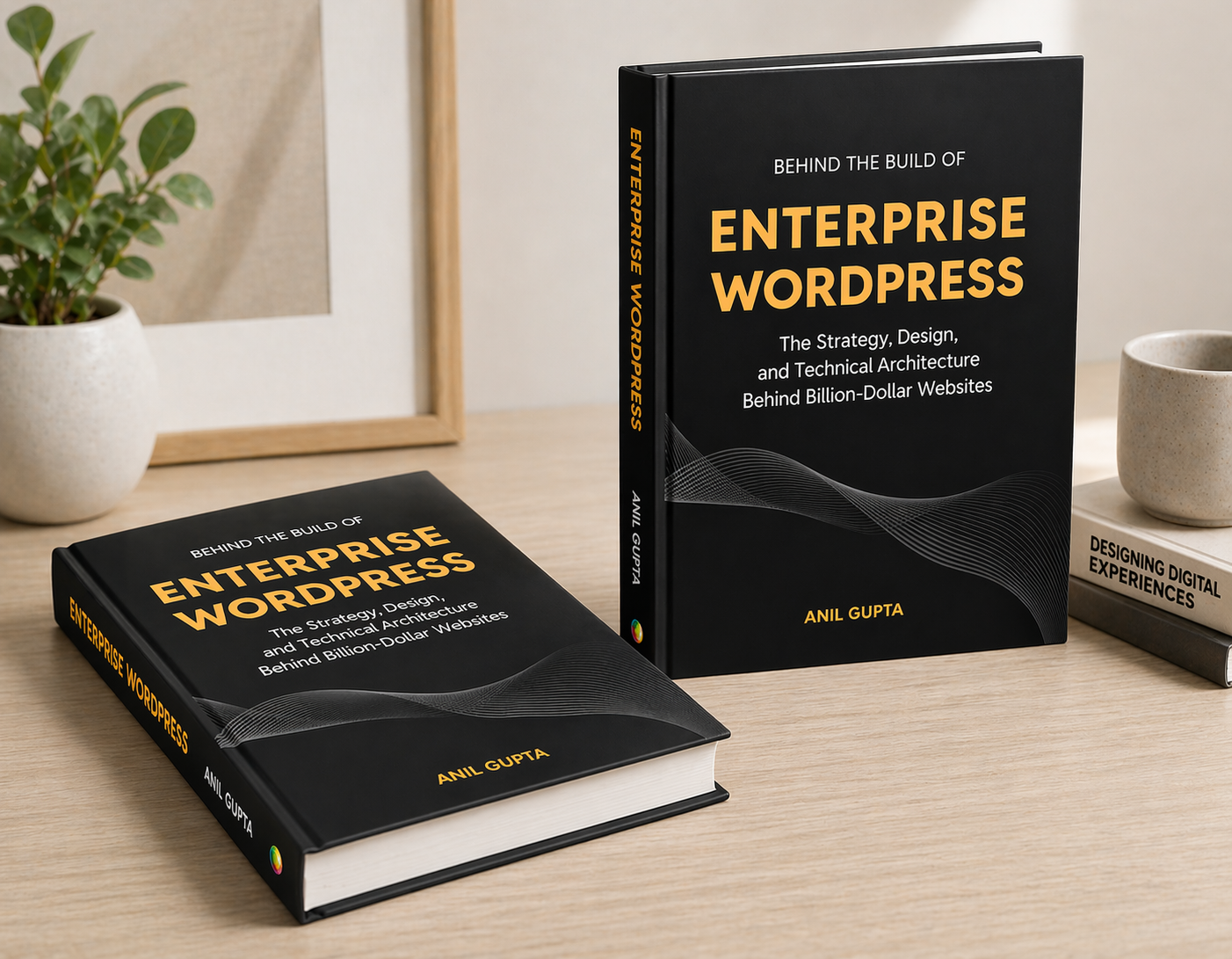
After more than a year of work, my book is finally ready—a comprehensive guide for tech leaders navigating the complexities of enterprise WordPress.
It's written for CTOs, IT managers, and enterprise decision-makers who want to understand how WordPress powers billion-dollar businesses.
Drawing from over a decade with Fortune 500 companies, I'm sharing strategies and insider knowledge most agencies keep to themselves.
What you'll learn:
- Evaluating WordPress for enterprise-scale operations
- Migration strategies that minimize risk and maximize ROI
- Performance optimization for high-traffic sites
- Security frameworks for enterprise compliance
- Team management for large WordPress deployments
The book is out now, and you can grab your copy today.
Ready to dive in? Order a copy of the book here.
👋 Until next time, Anil | CEO and Co-Founder → Multidots, Multicollab & Dotstore.
P.S. I also write about personal growth and agency growth.

WP for ENTERPRISES is brought to you by Multidots, an enterprise WordPress web agency that’s been empowering big enterprises to scale and succeed with WordPress.

Whenever you're ready (no pressure), there are four ways we can help:
#1: Enterprise WordPress consulting – Think of us as your WordPress GPS. We’ll get you where you need to go.
#2: Migrate your website to WordPress – No stress, no mess—just a smooth ride to the WP world.
#3: Designing and building a new site – Your dream site, minus the nightmares.
#4: Optimizing and maintaining your site – Because nobody likes a slow website (or a hangry one).
📆 Book a quick, free call—no hassle, no commitment, just solutions that work for you.
Member discussion