
How News Corp Australia Runs 90+ Brands on WordPress
Welcome to WP for ENTERPRISES, where we go behind the scenes of BILLION-DOLLAR WordPress websites.
In this issue, you'll discover:
- How Australia's largest media company migrated 90+ brands to WordPress.
- Why their legacy CMS was costing them millions and rendering pages in 27 seconds.
- 5 strategies that powered the largest open-source CMS migration in publishing history.
- The custom syndication engine that manages 6 million stories across 21 websites.
- The results that made this migration legendary.
Here's what makes this story different from anything we've covered before.
We're not talking about one website. Or even ten.
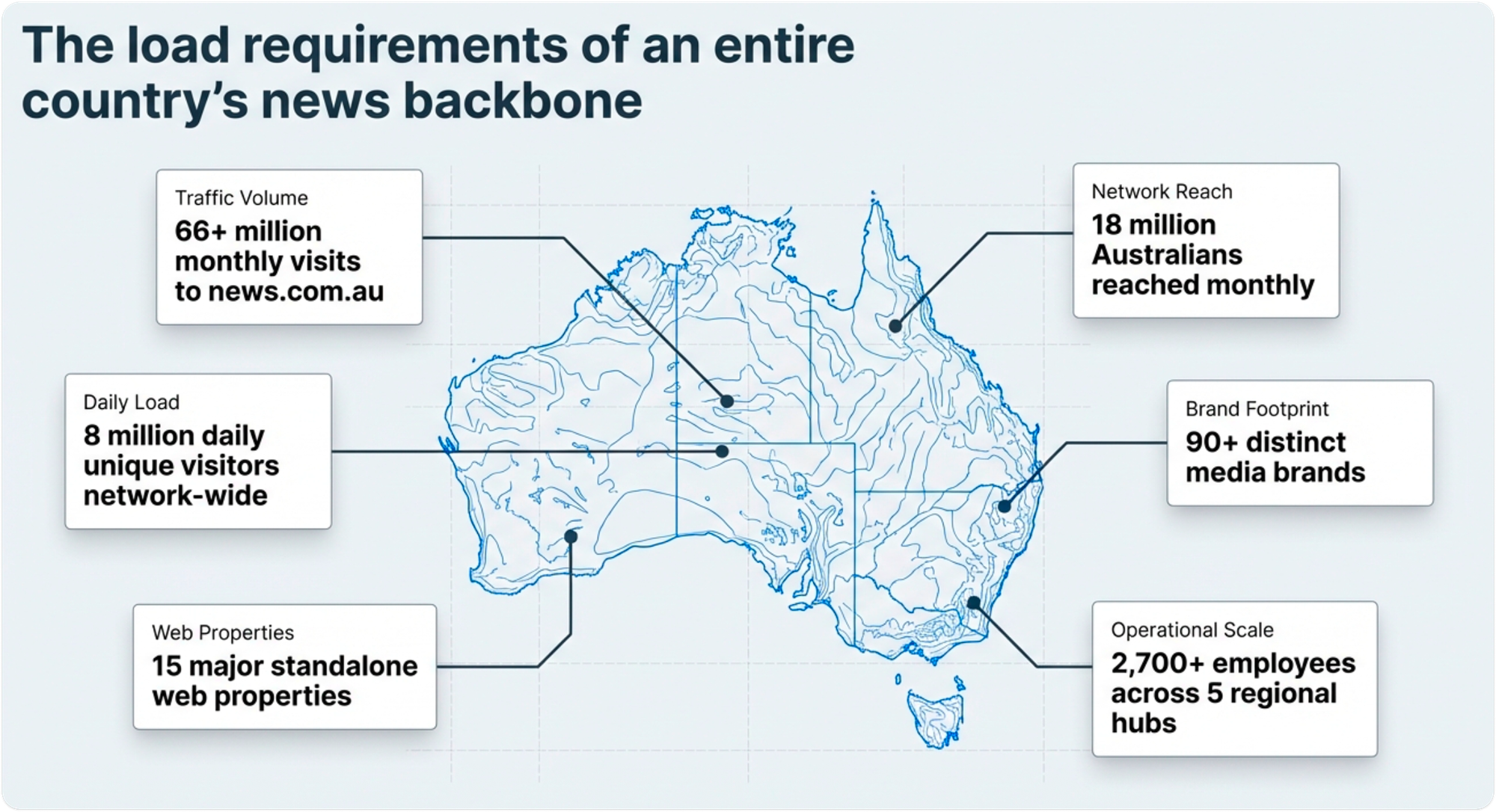
We're talking about 90+ media brands, 15 major web properties, and 500 million monthly page views—all running on the same platform.
News Corp Australia is the country's largest media company. Over 100 years of history. 2,700+ employees. Mastheads like The Australian, the Daily Telegraph, the Herald Sun, the Courier-Mail, and news.com.au—Australia's #1 news site with 66+ million monthly visits.
They reach approximately 18 million Australians every month. That's nearly 70% of the country's population.
And all of it runs on WordPress.
But getting there? That was the hard part.
And keeping it evolving at this scale? That's been our work at Multidots since 2020.
WHAT WAS BREAKING?
In 2014, News Corp Australia's digital infrastructure was falling apart.
They were running on a patchwork of legacy platforms. FatWire (Oracle-based) handled digital publishing. Méthode managed print editions. Neither system talked to the other.
Here's what their teams were dealing with:
Workflow Paralysis
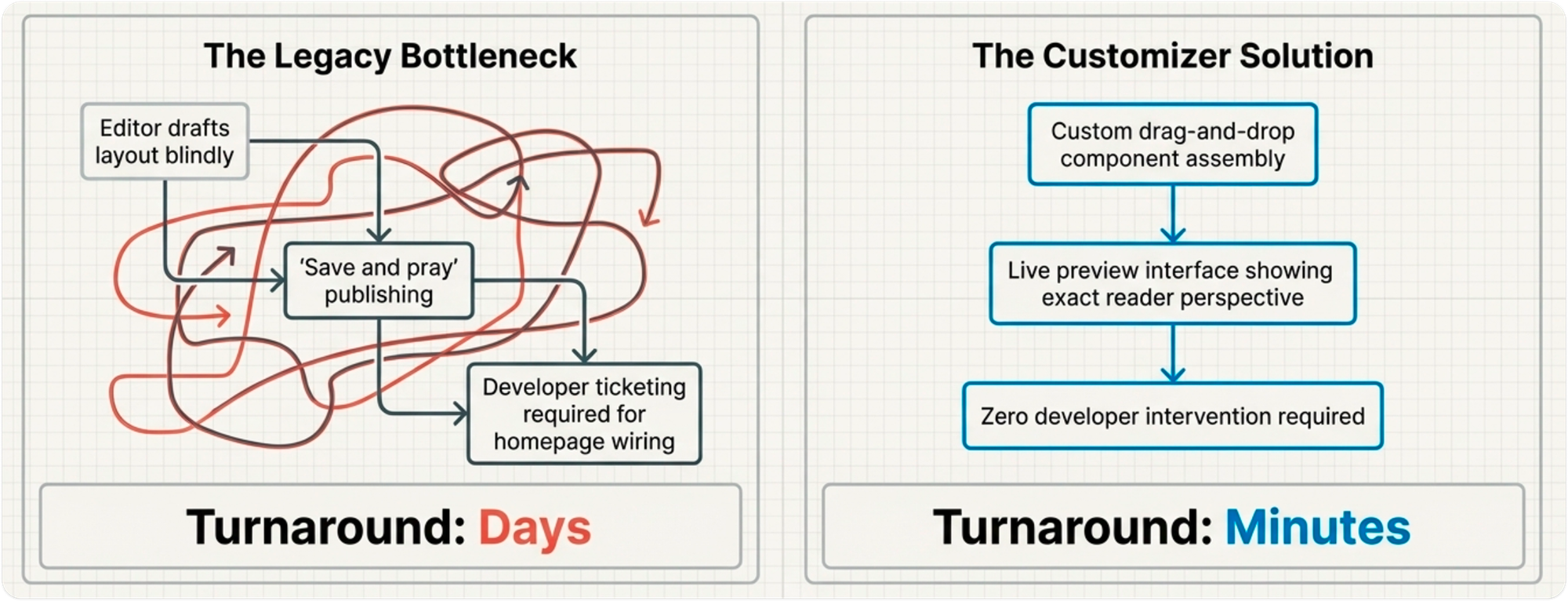
Thousands of daily content submissions required approval checkpoints across disconnected systems. Creating a category? You had to do it twice—once in FatWire, once in Méthode. Page layouts that an editor should assemble in a few clicks required developer involvement and days of turnaround.
Frankenstein Tech Stack
Years of acquisitions had created a fragmented infrastructure built on proprietary platforms with expensive licensing, specialized (read: expensive and hard to find) developers, and zero flexibility. The engineering team spent more energy keeping legacy systems alive than building features.
Monthly Release Cycles
Monthly. In an industry where breaking news waits for no one. Simple fixes sat in a queue for weeks before reaching production. FatWire couldn't even support mobile publishing properly.
27-Second Page Loads
Twenty-seven seconds. For a news website where every second of delay pushes readers to a competitor. At 500 million monthly page views, that kind of latency wasn't just a UX problem. It was a revenue problem.
The bottom line? The technology meant to empower journalists was actively holding them back.
WHY WORDPRESS?
News Corp Australia's reasons will sound familiar if you've been following this newsletter:
Editors already knew it
Thousands of journalists needed to adopt the new system fast. WordPress's familiarity meant lower training costs and faster rollout across the entire organization.
Open source, no vendor lock-in
After being burned by proprietary platforms, they wanted a CMS where they could see the source code, modify it freely, and never be held hostage by a vendor's licensing decisions or product roadmap.
Massive developer ecosystem
Finding FatWire developers in Australia was expensive and difficult. WordPress developers? Everywhere. That talent pool matters at enterprise scale.
Cost elimination.
Cutting proprietary licensing and on-premise hardware costs was an immediate financial win.
But here's the key insight: WordPress didn't meet their performance needs out of the box. They knew that going in.
What WordPress offered was the flexibility to build custom solutions at scale—without the proprietary restrictions that had crippled them before.
Before committing 90+ brands, they ran a smart pilot: The Australian's BusinessNow blog on WordPress VIP. It validated their assumptions. It gave leadership the confidence to greenlight everything.
5 STRATEGIES BEHIND THE MIGRATION
News Corp Australia partnered with WordPress VIP and XWP (the technical migration partner) for what became a year-long, three-party collaboration—and the largest open-source CMS migration the publishing industry had ever seen.
Here's how they pulled it off.
Strategy #1: Unified Platform Architecture (SPP)
Rather than treating each property as a separate WordPress installation, they built the Site Production Platform (SPP)—a unified foundation shared across all brands.
It consisted of:
- A core suite of VIP-approved plugins providing shared functionality across all sites.
- A base theme as the architectural foundation for every property.
- 22 custom child themes layered on top, giving each brand its distinct visual identity.
- 45+ custom plugins integrating WordPress with News Corp Australia's broader systems.
Same principle Disney used with their "Aloha" parent theme. Build once, customize per brand, maintain centrally.
When a security patch hits the base layer, all 90+ brands benefit simultaneously. No more patching 15 separate codebases.
Years later, we at Multidots used this same SPP foundation to help News Corp Australia launch new mastheads — The OZ (The Australian), Punters, Racenet, and CodeSports — without rebuilding from scratch.

Strategy #2: No-Code Layout Assembly
Here's where they solved one of the hardest problems in enterprise publishing: letting non-technical editors build complex page layouts without touching code.
They built a custom "Site Build" experience powered by the WordPress Customizer. Web producers could assemble complex, multi-section layouts by dragging and dropping components—all with live preview showing exactly how readers would see it.
No more "save and pray." No more waiting days for a developer to wire up a new homepage layout.
This implementation was so significant that their work on content previewing actually influenced WordPress core development.
The impact? Page layout creation went from days to minutes. A 40x improvement.
Multidots later took the editor experience further with Template 2.0—Full Site Editing, Pattern Manager, and reusable Gutenberg blocks across all mastheads.
Strategy #3: Kurator—The Content Syndication Engine
This is the piece that made the implementation truly world-class.
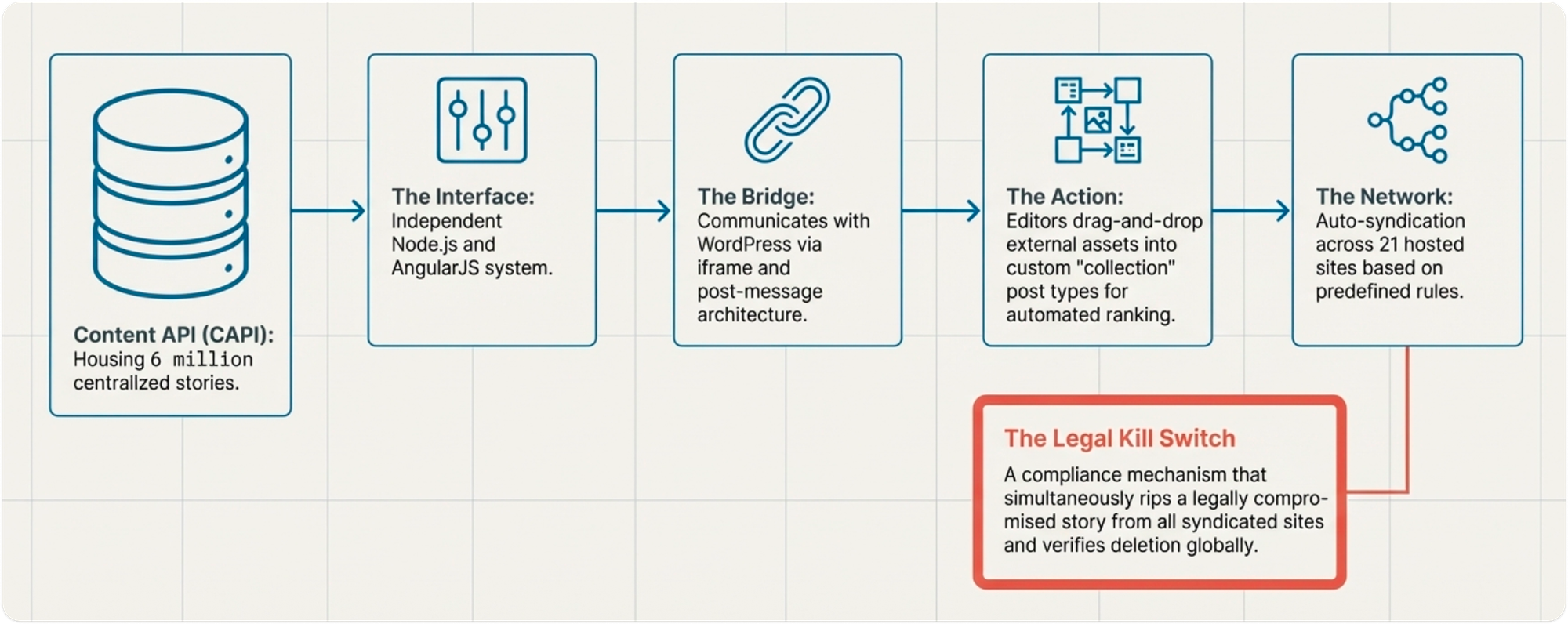
They built Kurator, a custom tool sitting on top of their Content API (CAPI), a centralized database of approximately 6 million stories.
Here's how it works:
- Editors open the Kurator panel directly inside WordPress.
- They search CAPI's 6-million-story database by section, topic, or keyword.
- They drag and drop stories, images, and videos directly into WordPress.
- Content syndicates automatically across 21 sites based on predefined rules.
- A "Legal Kill" function removes a story from every syndicated site simultaneously for legal compliance.
Kurator also handles homepage curation through "collections"—custom post types where editors rank stories for feature placement. This is how news.com.au decides what 8 million daily visitors see first.
Built on Node.js with AngularJS. Maintained by just three engineers. A testament to how well it was designed.
WordPress is the publishing engine. But at this scale, you need content infrastructure around it: syndication, curation, legal compliance. WordPress's extensibility made Kurator possible. A proprietary CMS would have made it a nightmare.
Strategy #4: Twig Templating for Multi-Brand Consolidation
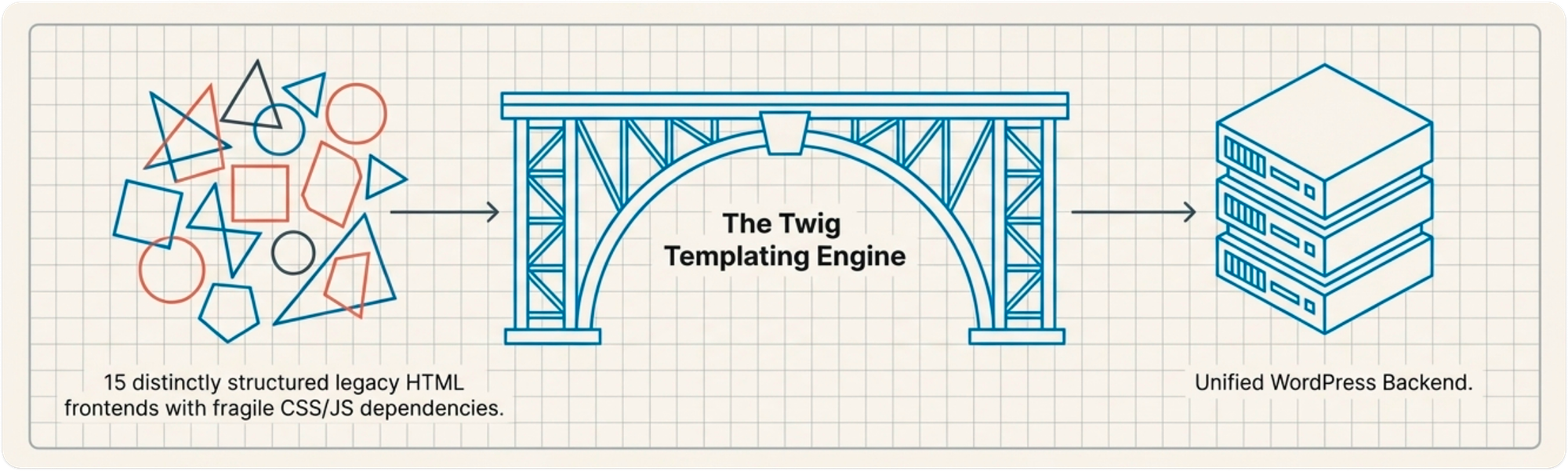
When 15 websites have 15 completely different HTML structures with unique CSS and JavaScript dependencies, you can't rebuild every frontend from scratch.
They used the Twig templating engine to reconcile disparate markup into a unified structure that worked with existing styles and scripts. Brands migrated without their frontends breaking. A pragmatic decision that saved months.
Strategy #5: Widget Architecture Re-Engineering
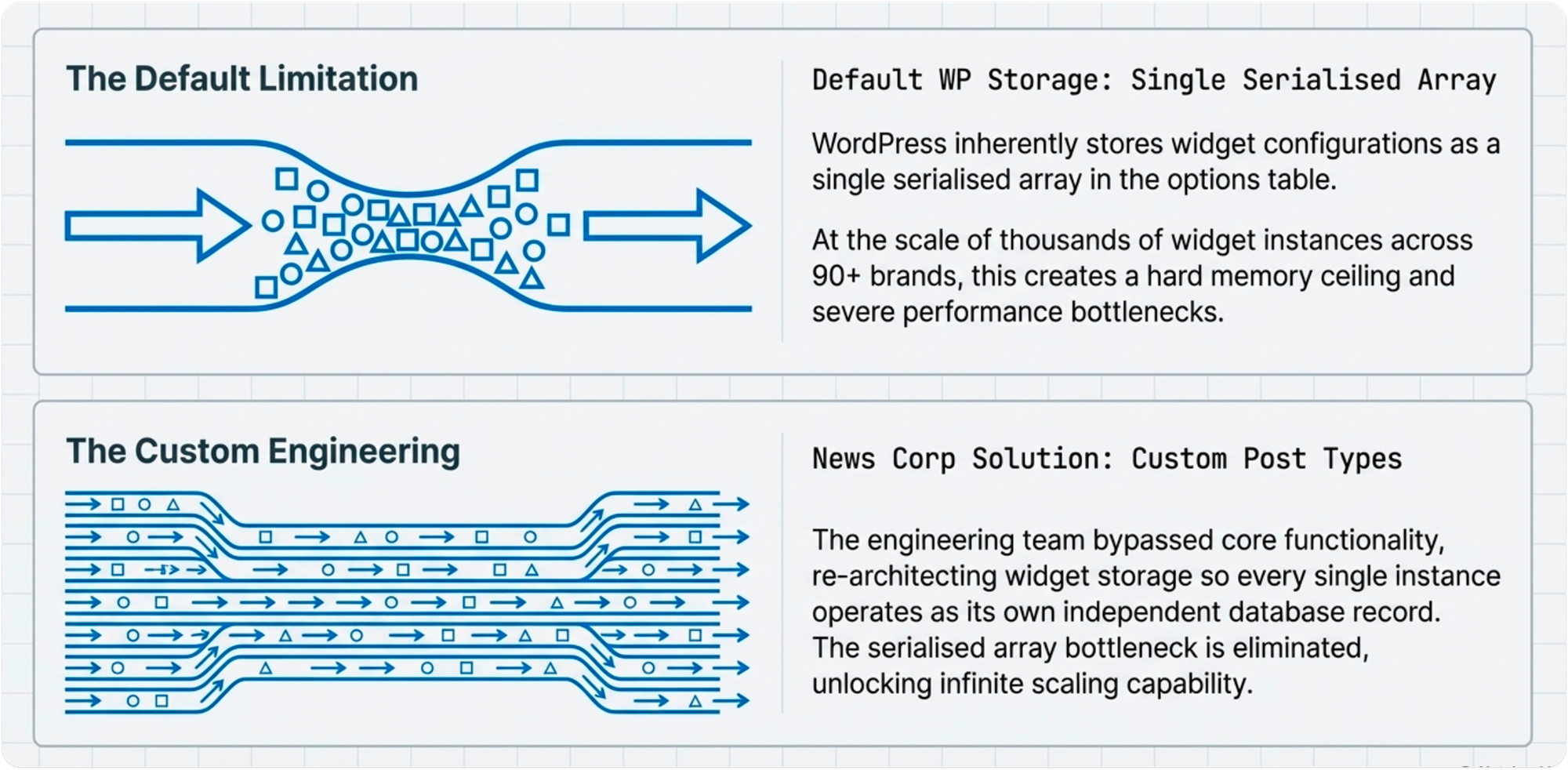
WordPress stores widget configurations as a single serialized array in the options table. Fine for a dozen widgets. At thousands of instances across 90+ brands? Memory issues and performance bottlenecks.
Their team re-architected widget storage into a custom post type—one database record per widget instance—eliminating the memory ceiling entirely.
This is the kind of deep WordPress engineering that separates enterprise implementations from standard ones. Understanding WordPress at the database level and rebuilding components when the defaults can't handle your scale.
THE RESULTS
The migration delivered across every dimension:
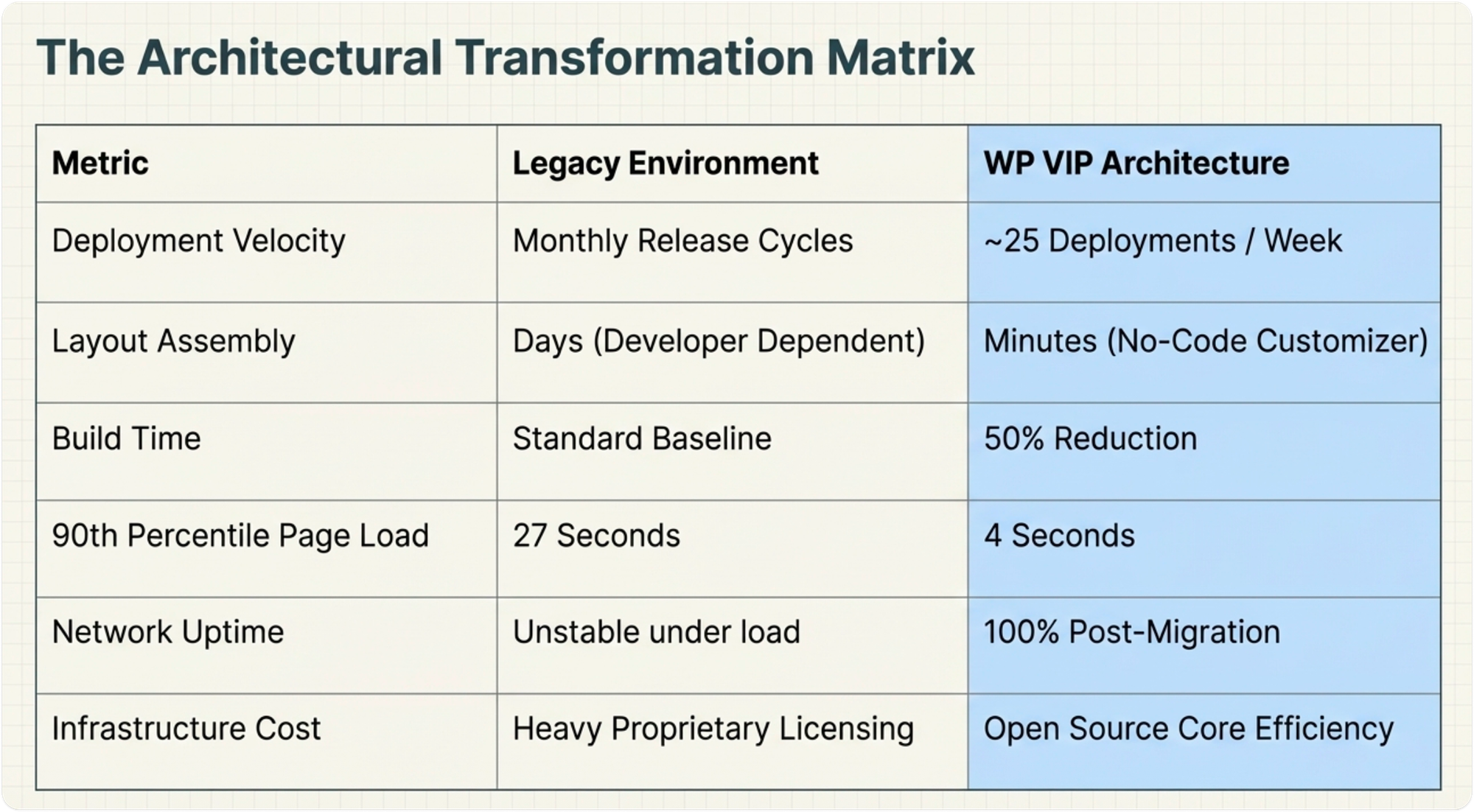
- Page render time dropped from 27 seconds to 4 seconds.
- Page layout creation improved 40x—from days to minutes.
- Release cycle went from monthly to ~25 deployments per week.
- Content creation volume tripled.
- Site traffic surged 82%.
- Publishing workflow became 60% faster.
- Daily publishing tasks cut from 10 minutes to 3 minutes.
- 100% uptime post-migration.
On the financial side, the migration eliminated proprietary licensing fees and on-premise hardware costs entirely—delivering significant savings from year one.
HOW THE PLATFORM KEPT EVOLVING
The 2014 migration was just the beginning. As News Corp Australia kept scaling, the platform needed to evolve too.
Since 2020, Multidots has helped them with the next chapter:
- Unified subscription infrastructure across 15+ mastheads on a single Multisite platform.
- Built dynamic subscription storefronts with custom checkout and confirmation flows.
- Integrated Google Subscribe and Extended Access for seamless reader monetization.
- Implemented a Customer Data Platform (CDP) with deep API integrations for personalized journeys.
- Migrated CI/CD from CircleCI to GitHub Actions for faster, more reliable deployments.
Enterprise WordPress isn't a one-time build. It's a platform that keeps growing — and that's the work we've been doing alongside their team.
FINAL THOUGHTS
News Corp Australia's migration is one of the most ambitious WordPress transformations ever attempted. And the lessons extend far beyond media and publishing.
✅ Run a pilot first. BusinessNow blog validated the platform before the organization committed. Smart risk management.
✅ Build a platform, not individual sites. The SPP approach turns a multi-site challenge into a force multiplier. One improvement benefits all 90+ brands.
✅ Invest in content infrastructure. Kurator shows that enterprise WordPress isn't just WordPress. It's the ecosystem of tools you build around it.
✅ Solve the editor experience. That 40x layout speed improvement freed journalists to do journalism instead of fighting their CMS.
✅ Don't fear WordPress's limits—engineer around them. Widget storage hit a ceiling? Rebuild it. Performance not there out of the box? Optimize it. Enterprise WordPress succeeds when you treat it as a foundation, not a finished product.
If Australia's largest media company can migrate 90+ brands and serve 500 million monthly page views on WordPress—your organization can probably pull it off too.
IN CASE YOU MISSED IT
By the way, in the previous issue, I shared "How NASA, Disney & Foursquare Use the WordPress REST API to Connect Their CMS to Everything". Check it out here.
In this issue, you'll discover:
- How the REST API turns WordPress into a content hub that talks to everything.
- The authentication methods that keep API access locked down at scale.
- How NASA, Disney, Foursquare, and Ask Media connect WordPress to dozens of external systems.
- A 4-stage maturity model to benchmark your own integration strategy.
 Anil Gupta
CHECK OUT THE BOOK
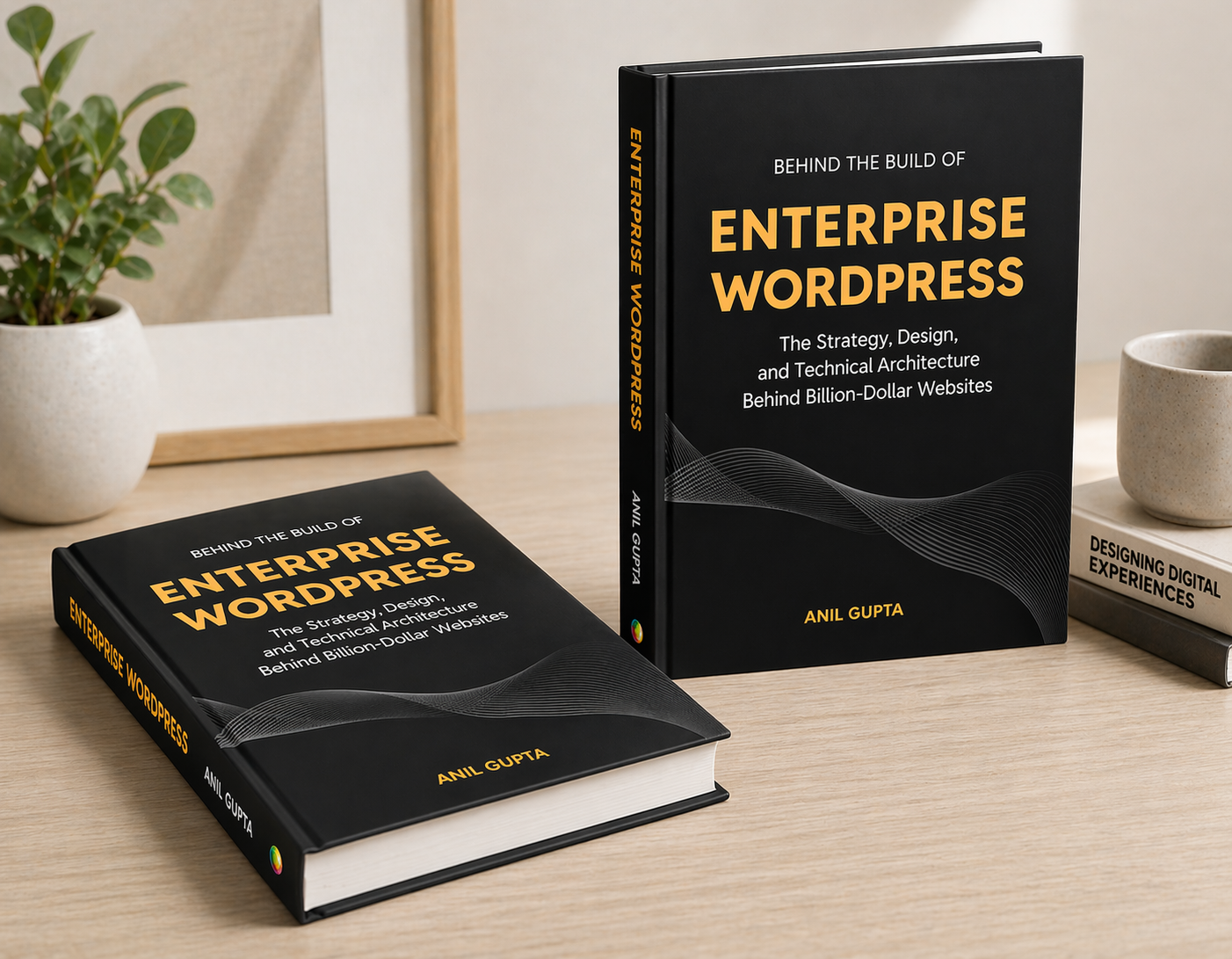
After more than a year of work, my book is finally ready—a comprehensive guide for tech leaders navigating the complexities of enterprise WordPress.
It's written for CTOs, IT managers, and enterprise decision-makers who want to understand how WordPress powers billion-dollar businesses.
Drawing from over a decade with Fortune 500 companies, I'm sharing strategies and insider knowledge most agencies keep to themselves.
What you'll learn:
- Evaluating WordPress for enterprise-scale operations
- Migration strategies that minimize risk and maximize ROI
- Performance optimization for high-traffic sites
- Security frameworks for enterprise compliance
- Team management for large WordPress deployments
The book is out now, and you can grab your copy today.
Ready to dive in? Order a copy of the book here.
👋 Until next time, Anil | CEO and Co-Founder → Multidots, Multicollab & Dotstore.
P.S. I also write about personal growth and agency growth.

WP for ENTERPRISES is brought to you by Multidots, an enterprise WordPress web agency that’s been empowering big enterprises to scale and succeed with WordPress.

Whenever you're ready (no pressure), there are four ways we can help:
#1: Enterprise WordPress consulting – Think of us as your WordPress GPS. We’ll get you where you need to go.
#2: Migrate your website to WordPress – No stress, no mess—just a smooth ride to the WP world.
#3: Designing and building a new site – Your dream site, minus the nightmares.
#4: Optimizing and maintaining your site – Because nobody likes a slow website (or a hangry one).
📆 Book a quick, free call—no hassle, no commitment, just solutions that work for you.
Member discussion